Tibetan Wheel of Life (Bhavachakra): A Psychological Map of Consciousness
The Tibetan Wheel of Life (Bhavachakra) operates as both a visual representation of Buddhist cosmology and a precise psychological framework mapping the mechanics of human consciousness and cyclic existence (samsara).[1] Rather than treating cyclic existence purely as a sequence of physical rebirths, Tibetan Buddhist tradition and modern contemplative psychology view the wheel as a real-time diagnostic tool for understanding how emotional poisons, karmic habits, and mental conditioning generate suffering.[2]
The Wheel of Life translates complex Buddhist metaphysics into a 5-part concentric diagram:[3]
-
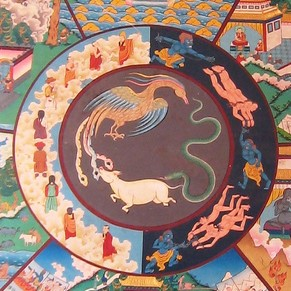
The Hub: The three fundamental emotional poisons (ignorance, aversion, attachment).
-
Second Layer: The dual paths of karma (ascension through light / descent through darkness).
-
Third Layer: The Six Realms of existence, mapped psychologically as states of mind.
-
Outer Rim: The 12 Links of Dependent Origination (Pratītyasamutpāda), showing how consciousness becomes trapped in repetitive cycles.
-
Outer Frame & Sky: Yama (the lord of death and impermanence) holding the wheel, alongside the Buddha pointing to the moon (liberation).
The Three Poisons: The Root Drivers of Mind
At the center of the wheel sit three interlocking animals representing the primary emotional defilements (kleshas) that power the engine of human reactivity.[1:1]
-
The Pig (Avidya / Ignorance): Symbolizes fundamental delusion and the lack of self-awareness. The pig sleeps in filth and eats indiscriminately, reflecting how ignorance operates by failing to recognize the interconnected and impermanent nature of reality.[4]
-
The Snake (Dvesha / Aversion & Anger): Symbolizes hostility, judgment, and rejection. Like a serpent striking out at the slightest touch, aversion arises when the ego feels threatened by unpleasant sensations.[1:2]
-
The Bird/Rooster (Raga / Attachment & Craving): Symbolizes clinging, desire, and obsession. Depicted as a passionate bird, it represents the restless mind constantly seeking external objects, feelings, or identity markers to validate its existence.[1:3]
In traditional iconography, the snake and bird emerge from the mouth of the pig, demonstrating that aversion and craving are direct psychological offshoots of fundamental ignorance.[3:1]
The Six Realms as Psychological States
While traditional Buddhist cosmology views the six realms (gati) as physical places of rebirth, spiritual teachers and psychotherapists emphasize their application as moment-to-moment states of mind experienced in daily life.[2:1]
According to Buddhist psychology, an individual does not need to physically die to experience the six realms. Human beings can rotate through these distinct mental states multiple times within a single day.[2:2]
1. God Realm (Deva-loka) — Pride & Complacency
-
Mental State: Euphoria, self-satisfaction, spiritual materialism, and temporary peace.[1:4]
-
Psychological Trap: Blissful ignorance of reality. The mind becomes intoxicated by pleasure or spiritual achievement, ignoring the suffering of others until impermanence inevitably shatters the state.[3:2]
2. Demi-God Realm (Asura-loka) — Envy & Competition
-
Mental State: Constant comparison, paranoia, jealousy, and hyper-competitiveness.[1:5]
-
Psychological Trap: The ego cannot enjoy its achievements because it is obsessed with those who have more power or status. Life is perceived as an endless battle for dominance.[3:3]
3. Human Realm (Manusya-loka) — Balance & Self-Awareness
-
Mental State: A fluctuating mix of pleasure, pain, desire, and intellectual curiosity.[1:6]
-
Psychological Trap: While prone to restlessness, the human realm provides the balance of suffering and clarity necessary for spiritual awakening.[1:7]
4. Animal Realm (Tiryag-loka) — Ignorance & Survival Mode
-
Mental State: Instinctual drive, fear, habituation, and resistance to change.[3:4]
-
Psychological Trap: Operating purely on reaction and routine. Consciousness becomes fixed in short-term comfort and self-preservation, lacking the reflective capacity to question its conditioning.[4:1]
5. Hungry Ghost Realm (Preta-loka) — Addiction & Unquenchable Craving
-
Mental State: Deep inner emptiness, chronic dissatisfaction, and addictive impulse.[1:8]
-
Psychological Trap: Depicted as beings with giant bellies and needle-thin necks, this state reflects the dynamic of addiction—where no amount of consumption can fill the underlying emotional void.[3:5]
6. Hell Realm (Naraka-loka) — Anger & Self-Destruction
-
Mental State: Intense rage, hatred, terror, and paranoid defensiveness.[1:9]
-
Psychological Trap: The mind projects its internal hostility onto the outer environment, perceiving everything as a threat and creating a self-perpetuating hell of intense mental agony.[3:6]
The 12 Links of Dependent Origination (Pratītyasamutpāda)
The outer rim of the Wheel illustrates how consciousness moves through twelve sequential links (nidanas), detailing how momentary psychological states solidify into ingrained identity structures and karmic cycles.[5]
| Link | Sanskrit Term | Symbolic Icon | Psychological Process |
|---|---|---|---|
| 1. Ignorance | Avidya | Blind person with a stick | Unawareness of reality's true nature.[4:2] |
| 2. Mental Formations | Sankhara | Potter shaping clay pots | Volitional actions and karmic conditioning.[5:1] |
| 3. Consciousness | Vijnana | Monkey leaping between trees | The restless focal point of mental awareness.[4:3] |
| 4. Name and Form | Namarupa | People in a boat | The emergence of mind-body identity.[5:2] |
| 5. Six Senses | Sadayatana | House with six windows | Senses framing reality (eye, ear, nose, tongue, body, mind).[4:4] |
| 6. Contact | Sparsa | Embracing couple | The meeting of sense organs, objects, and awareness.[5:3] |
| 7. Feeling | Vedana | Arrow piercing an eye | Raw affective charge (pleasant, unpleasant, neutral).[4:5] |
| 8. Craving | Trsna | Person drinking alcohol | The automatic urge to grasp pleasure or avoid pain.[5:4] |
| 9. Grasping | Upadana | Person picking fruit from a tree | Attachment solidifying into habits and dogmas.[4:6] |
| 10. Becoming | Bhava | Pregnant woman | The process of karmic momentum taking shape.[5:5] |
| 11. Birth | Jati | Woman giving birth | The manifestation of a new mental state or identity.[4:7] |
| 12. Aging & Death | Jaramarana | Corpse carried to burial | The inevitable decay and dissolution of that mental state.[5:6] |
Liberation, Impermanence, and the Observer Mind
The entire wheel is held within the jaws and claws of Yama, the deity representing impermanence and time.[2:3] This signifies that every conditioned mental state, whether heavenly or hellish, is subject to constant change and eventual decay.
Outside the wheel, two critical symbols point toward the resolution of cyclic suffering:
-
The Moon: Represents liberation (nirvana) and the unconditioned nature of mind beyond dualistic projections.[3:7]
-
The Buddha Pointing: Represents the practical path of awareness (the Dharma). The Buddha stands outside the wheel, demonstrating that consciousness is not required to remain trapped in cyclic reactivity.[1:10]
In Buddhist contemplative practice, the transition between Link 7 (Feeling / Vedana) and Link 8 (Craving / Trsna) serves as the primary intervention point.[1:11] When a feeling arises (symbolized by the arrow in the eye), mindfulness allows one to experience the raw sensation without reacting with craving or aversion, thereby breaking the automatic chain of dependent origination.[4:8]
Resonant Notes
The following vault notes resonate with the themes and concepts explored in the Tibetan Wheel of Life:
🔥 Strong Resonance (Direct Doctrinal Overlap)
-
The Core Distinction-Epistemologies of Consciousness and Awareness in Nāgārjuna's Madhyamaka and Jungian Analytical Psychology — Directly engages with the 12 Links of Dependent Origination (Pratītyasamutpāda), explaining how vijñāna (dualistic consciousness) serves as the karmic seed that propels beings through saṃsāra. This is the philosophical backbone of the Wheel's outer rim.
-
Constructs of the Mind-Unmasking Consciousness in East and West — Covers the same Dependent Origination framework, detailing how ignorance (avidyā) → mental formations → consciousness → name & form → six sense bases → contact → feeling → craving → grasping → becoming → birth → aging & death. Mirrors the Wheel's 12-link sequence exactly.
-
The Generative Eye (McGilchrist and Buddhism) — Maps the Wheel's mechanics onto neuroscience, explaining how unwise attention (ayoniso manasikāra) — the cognitive mode that keeps the Wheel spinning — corresponds to left-hemisphere dominance. Mindfulness (sati) is presented as the catalyst for breaking the cycle.
-
Reflexive Loop-Attention and Intention in McGilchrist and Buddhism — Contains a recursive loop diagram showing how Right Intention → Wise Attention → Deconstructed Seeds → Liberated Consciousness breaks the Wheel's cycle. Directly addresses the pivot point between feeling and craving (Links 7→8).
-
Epistemology of Preference-Avijjā, Māna, and the Emptiness of Aesthetic Taste in Buddhist Philosophy — Deeply explores Avijjā (ignorance) as the root of all saṃsāric entanglement, the first link of the Wheel. Analyzes the Three Marks of Existence (anicca, dukkha, anattā) that the Wheel's six realms obscure.
🧠 Strong Resonance (Psychological & Neurobiological)
-
Mindfulness Meditation and DMN Activity — The Default Mode Network (DMN) is the neural substrate for the self-referential narrative that keeps the Wheel spinning. Mindfulness meditation down-regulates DMN hubs (PCC/mPFC), offering a neurobiological mechanism for breaking the craving link.
-
Noble Eightfold Path - Right Effort, Right Mindfulness, and Right Concentration — The practical path that leads out of the Wheel. Right Mindfulness (Sammā Sati) is the precise intervention at the feeling→craving juncture that the Wheel identifies as the pivot point of freedom.
-
Cognitive Filters in Buddhism — Explains how Avijjā functions as an active misperception filter, driving the reification error (svabhāva) that solidifies fluid processes into fixed objects — the cognitive mechanism underlying all six realms.
🌀 Resonant (Comparative & Philosophical)
-
Schopenhauerian Pessimism — Schopenhauer's "pendulum between pain and boredom" is a Western philosophical echo of the Wheel's six realms. His concept of the blind, endless Will parallels the Three Poisons driving the Wheel, and his three paths of deliverance (aesthetic contemplation, compassion, asceticism) mirror Buddhist liberation.
-
Jung And Buddha Common Ground — Explores the ego-Self relationship through both Jungian and Buddhist lenses, touching on the illusion of the separate self (anattā) that the Wheel's hub (Three Poisons) depends upon. The Jungian process of individuation parallels the path out of cyclic existence.
-
Gestalt and Buddhism-Reality Construction — The self as an illusory Gestalt — the mind's tendency to synthesize a unified "Self" from the five aggregates — explains how the Wheel's psychological trap operates. Clinging (Upadāna) to this constructed self fuels the engine of dukkha.
-
Dissolving vs. Evolving-The Self in Buddhism and Jung — Contrasts the Buddhist deconstruction of self (the Wheel's solution) with Jungian individuation, providing a comparative framework for understanding the Wheel's soteriological goal.
-
The Three Turnings of the Wheel - Hermeneutics of Mahāyāna Philosophy — Contextualizes the Wheel of Life within the broader Mahāyāna framework, covering the Four Noble Truths, Three Marks of Existence, and Dependent Origination that the Wheel visually encodes.
-
From Truths to Tasks - Stephen Batchelor’s Secular Reworking of the Four Noble Truths — Batchelor's redefinition of Nirvana as any moment where habitual reactivity stops offers a secular, immanent reading of the Wheel's liberation — the moon outside the Wheel, accessible in daily life.
References
Encyclopedia of Buddhism / Wheel of Life / encyclopediaofbuddhism.org ↩︎ ↩︎ ↩︎ ↩︎ ↩︎ ↩︎ ↩︎ ↩︎ ↩︎ ↩︎ ↩︎ ↩︎
University of Idaho Library / Bhavacakra (Wheel of Becoming / Wheel of Life) / lib.uidaho.edu ↩︎ ↩︎ ↩︎ ↩︎
Wikipedia Editors / Bhavacakra / en.wikipedia.org ↩︎ ↩︎ ↩︎ ↩︎ ↩︎ ↩︎ ↩︎ ↩︎
Pathgate Institute of Buddhist Studies / Reflection on the Twelve Links of Dependent-Origination / pathgate.org ↩︎ ↩︎ ↩︎ ↩︎ ↩︎ ↩︎ ↩︎ ↩︎ ↩︎
Boudha Stupa Thanka Center / 12 Links of Dependent Origination: 12 Nidanas in Buddhism / bstcthanka.com ↩︎ ↩︎ ↩︎ ↩︎ ↩︎ ↩︎ ↩︎