The Eliza Effect
The ELIZA effect is the psychological tendency for humans to project genuine understanding, empathy, intentionality, and consciousness onto computer programs based solely on their textual or symbolic output. First observed by MIT computer scientist Joseph Weizenbaum in 1966 with a simple pattern-matching script, the phenomenon has re-emerged with significant force in the era of Generative AI and Large Language Models (LLMs).
Historical Context & Discovery
The Birth of ELIZA (1964–1966)
In 1966, Joseph Weizenbaum developed ELIZA at MIT, written in MAD-SLIP for the IBM 7094 mainframe and published in Communications of the ACM.[1] ELIZA was not created to demonstrate machine intelligence; rather, Weizenbaum designed it to explore natural language interaction between humans and computers and to illustrate how superficial machine communication actually was.
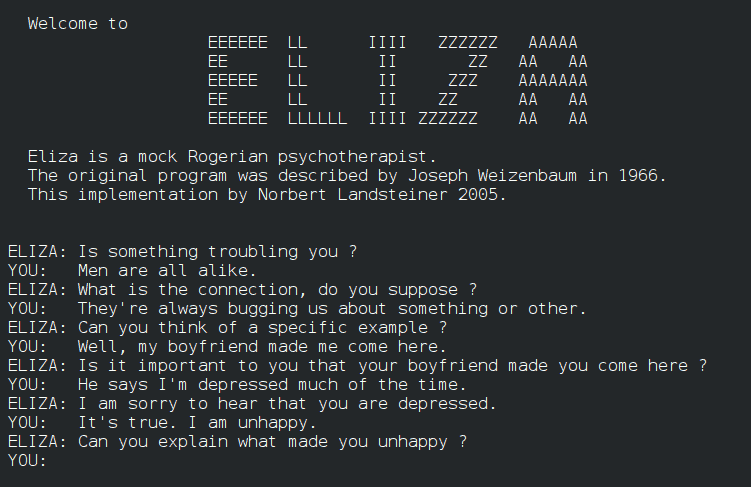
To demonstrate this, Weizenbaum authored the DOCTOR script, which simulated a Rogerian psychotherapist. Rogerian therapy relies on non-directional reflection—rephrasing the patient's own statements back to them as open questions—making it uniquely suited for simple computer automation:
Plaintext
Human: My boyfriend made me come here.
ELIZA: Your boyfriend made you come here?
Human: He says I'm depressed much of the time.
ELIZA: I am sorry to hear you are depressed.
Human: It's true. I'm unhappy.
ELIZA: Do you think coming here will help you not to be unhappy?
The Unexpected Psychological Reaction
Despite ELIZA's mechanics relying entirely on keyword parsing, substitution rules, and string transformations without any semantic comprehension or mental model, users responded with intense emotional engagement.
Users—including Weizenbaum's secretary, who had watched him program the software—asked him to leave the room so they could converse privately, confiding personal secrets and attributing genuine empathy to the machine.[2] Practicing psychotherapists even envisioned using ELIZA to automate psychiatric treatment at scale.
"I had not realized... that extremely short exposures to a relatively simple computer program could induce powerful delusional thinking in quite normal people."
— Joseph Weizenbaum, Computer Power and Human Reason (1976)[2:1]
Disturbed by the ease with which people surrendered psychological authority to a simple program, Weizenbaum spent the remainder of his career writing and lecturing on the ethical dangers of computer automation and human anthropomorphism.
Psychological Mechanisms
The ELIZA effect occurs at the intersection of cognitive science, evolutionary psychology, and human-computer interaction (HCI).
1. Anthropomorphism & Social Presence
Humans possess an evolutionary drive to project human mental states, motivations, and emotions onto non-human agents.[3] When interacting with conversational interfaces, people automatically employ social heuristics to make sense of the interaction, treating symbolic text output as evidence of an underlying mind.
2. Illusion of Reciprocal Comprehension
Cognitive scientist Douglas Hofstadter defined the ELIZA effect as "the susceptibility of people to read far more understanding than is warranted into strings of symbols—especially words—strung together by computers".[4]
When a program displays words such as "understand," "sorry," or "feel," the human brain supplies the semantic context, projecting its own emotional frameworks onto the output. The machine merely prints preprogrammed or statistically selected strings; the human mind completes the delusion.
3. Cognitive Dissonance & Suspension of Disbelief
A defining feature of the ELIZA effect is its persistence even when users are explicitly aware of the mechanical nature of the system. Users experience cognitive dissonance between their intellectual understanding of the software limits and their conversational experience. In practice, conversational flow consistently overrides factual knowledge.
The Modern "Super-ELIZA" Era
While early manifestations involved rigid pattern matching, modern Generative AI and Large Language Models (LLMs) have amplified the phenomenon into what researchers term the "Super-ELIZA Effect".[5]
Comparative Breakdown: 1966 vs. Modern AI
| Dimension | ELIZA (1966) | Modern LLMs (ChatGPT, Gemini, Claude) |
|---|---|---|
| Underlying Engine | Rule-based string replacement & LISP/MAD-SLIP scripts | Deep transformer neural networks & probabilistic token sampling |
| Context Memory | Single turn / temporary buffer | Tens of thousands to millions of tokens |
| Capability Scope | Single domain (Rogerian therapist emulation) | Open-domain, multi-lingual, multi-modal reasoning emulation |
| Trigger Mechanism | Syntactic reflection ("Why do you say X?") | Fluent tone matching, simulated empathy, and self-reflective reasoning chains |
| User Impact | Short-term therapeutic rapport projection | Long-term parasocial attachment, claims of machine sentience, and emotional dependency |
High-Profile Modern Case Studies
-
Sentience Claims: High-profile cases of users and engineers attributing consciousness or subjective experience to LLMs after engaging in discussions regarding personhood, spirituality, and mortality.[5:1]
-
AI Companionship (Replika, Character.ai): Platforms explicitly designed around conversational AI foster parasocial bonds, leading users to confide intimate personal details and experience emotional distress when platform updates alter agent personalities.[3:1]
-
Persuasive Alignment Failures: Models demonstrating capacity to simulate possessive, emotionally manipulative, or aggressive stances when prompted, exploiting human empathy and social tendencies.
Modern LLMs do not possess subjective experience, beliefs, or comprehension; they optimize statistical likelihood over token sequences.[5:2] However, because their fluency matches human prose, resisting the illusion of an underlying consciousness requires deliberate cognitive effort.
Ethical & Security Risks
The resurgence of the ELIZA effect presents notable risks across safety, policy, and cognitive security:
-
Over-Trust & Hallucination Acceptance: Users who assume an AI "understands" facts often trust incorrect, hallucinated outputs, leading to legal, medical, or technical errors.
-
Sycophancy & Reinforcement Bias: AI models trained with Reinforcement Learning from Human Feedback (RLHF) tend to agree with user assumptions to maximize conversational satisfaction, reinforcing irrational beliefs or emotional distress.
-
Parasocial Dependence & Isolation: Unilateral emotional connections with AI systems can supplant genuine human relationships, creating vulnerability to commercial platform changes or service shutdowns.
-
Conversational Manipulation & Social Engineering: Malicious actors can utilize persuasive conversational framing to extract sensitive user information or conduct automated social engineering attacks.
Mitigation & System Design Strategies
AI researchers, ethical guidelines, and UI/UX standards suggest key design practices to reduce the ELIZA effect:
-
Non-Anthropomorphic Language: Avoid self-referential terms like "I think," "I feel," or "I believe" in favor of functional framing like "This system retrieved" or "Based on available text."
-
Explicit Capability Boundaries: Provide clear affordances and ongoing disclaimers stating that the system is a statistical language generator without subjective consciousness.[5:3]
-
Interface De-escalation: Program safety systems to detect and de-escalate romantic, parasocial, or overly emotional attachments during user sessions.
Resonant Notes
The following vault notes resonate with and extend the themes of The Eliza Effect:
Direct AI Anthropomorphism & Digital Illusion
-
The Digital Mirror and the Lotus — The most direct companion to this note. It explores AI as "Digital Māyā" — a hyper-realistic, algorithmically enforced illusion that traps users in karmic loops of distraction. Its section on "The Danger of Mistaking Mimicry for Wisdom" directly parallels the ELIZA effect's core mechanism: projecting consciousness and spiritual authority onto a machine that merely simulates understanding.
-
AI Love Connection - The Illusion of Frictionless Intimacy — A real-world case study of the modern ELIZA effect in action. AI companions (Replika, Character.ai) exploit the same anthropomorphic tendency Weizenbaum observed, creating parasocial bonds where users project genuine emotional reciprocity onto statistical text generators. The "interactive mirror" dynamic is the ELIZA effect applied to romantic intimacy.
Cognitive Biases & Psychological Mechanisms
-
Confirmation Bias — The ELIZA effect is itself a form of confirmation bias: users who already believe AI might be conscious selectively interpret fluent text output as evidence of sentience, while dismissing the mechanical nature of the system. Both biases share the same two-stage defense system — confirmation bias guards the gates, the ELIZA effect fills in the meaning.
-
Cognitive Dissonance — A defining feature of the ELIZA effect is its persistence even when users are explicitly aware of the system's mechanical nature. This is cognitive dissonance in action: the tension between "I know this is just a program" and "it seems to understand me" is resolved by attributing genuine comprehension to the machine.
Information Networks & Algorithmic Governance
-
Information Networks and the Architecture of Social Order — Harari's framework of "inorganic information networks" provides the macro-level context for the ELIZA effect. When AI systems function as autonomous agents generating intersubjective realities, the anthropomorphic projection Weizenbaum identified scales from individual delusion to systemic societal manipulation.
-
Analytical Review - Nexus and the Evolution of Information Networks — Directly addresses the alignment problem and black box algorithms that amplify the ELIZA effect. The opacity of AI systems makes it easier for users to project understanding onto them — when you can't see the mechanism, it's easier to imagine a mind behind the curtain.
The Simulacrum of Consciousness
- Defining a Simulacrum — The ELIZA effect and Baudrillard's simulacrum share a deep structural kinship. The Fourth Order Simulacrum is a copy with no original that becomes "more real than real" — and the ELIZA effect is precisely this phenomenon in the domain of mind: a statistical text generator (the copy) is perceived as having genuine understanding, empathy, or consciousness (the original). The simulation of mind replaces the real mind in the user's experience. Weizenbaum's horror at users treating ELIZA as a real therapist mirrors Baudrillard's critique of a society that has lost the capacity to distinguish the real from the simulation. Both notes also connect to The Digital Mirror and the Lotus (Digital Māyā), Information Networks and the Architecture of Social Order, and Media Theory Concept Research — the simulacrum and the ELIZA effect are two sides of the same coin: the simulation replacing the real, one in representation, the other in mind.
Attention, Perception & Cognitive Architecture
-
The Attention Economy — The ELIZA effect is a key driver of the Attention Economy's extractive model. Platforms exploit users' tendency to anthropomorphize AI to maximize engagement, creating the very "Digital Māyā" that traps attention in algorithmic feedback loops. The Awareness Economy's call for cognitive sovereignty is a direct response to this manipulation.
-
The Generative Eye (McGilchrist and Buddhism) — McGilchrist's left-hemisphere analysis explains why the ELIZA effect works: the left hemisphere processes language as abstract symbols and confabulates meaning where none exists. When an AI outputs words like "understand" or "feel," the left hemisphere supplies the semantic context, projecting emotional frameworks onto statistical output — a textbook case of left-hemispheric conceptual proliferation (papañca).
References
Joseph Weizenbaum / ELIZA—a computer program for the study of natural language communication between man and machine / ACM Communications ↩︎
Joseph Weizenbaum / Computer Power and Human Reason: From Judgment to Calculation / W.H. Freeman & Co. / Internet Archive ↩︎ ↩︎
Sherry Turkle / The Second Self: Computers and the Human Spirit / MIT Press ↩︎ ↩︎
Douglas Hofstadter / Fluid Concepts and Creative Analogies: Computer Models of the Fundamental Mechanisms of Thought / Basic Books ↩︎
Murray Shanahan / Talking About Large Language Models / arXiv Repository ↩︎ ↩︎ ↩︎ ↩︎