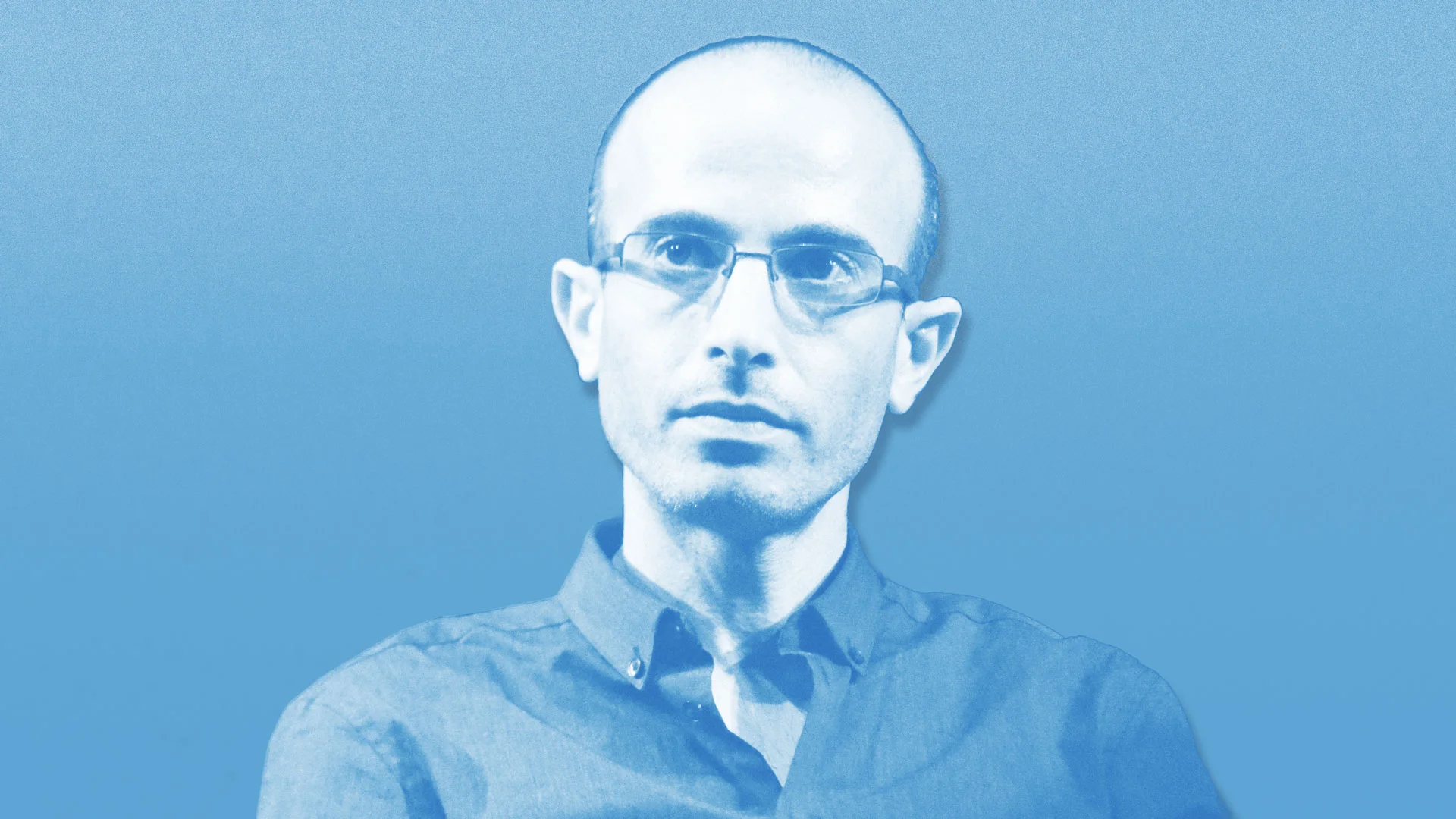
Yuval Noah Harari
Israeli historian and philosopher Yuval Noah Harari is best known for his broad-sweep "Big History" works, including Sapiens: A Brief History of Humankind, Homo Deus: A Brief History of Tomorrow, 21 Lessons for the 21st Century, and Nexus: A Brief History of Information Networks from the Stone Age to AI.[1] Harari’s primary theories center on how Homo sapiens achieved global dominance through shared fictions, how technological revolutions threaten to displace human authority, and how information networks balance the ongoing tension between truth and social order.[2]
Core Theories and Theoretical Frameworks
1. Intersubjective Reality and the Power of Shared Fictions
Harari argues that the defining turning point in human evolution was the Cognitive Revolution (occurring approximately 70,000 years ago).[3] While other animals interact exclusively with objective reality (e.g., rivers, trees, predators) and subjective reality (e.g., individual fear or hunger), Homo sapiens developed the unique cognitive capacity to construct and believe in an intersubjective reality—entities that exist purely within communication networks across millions of minds.[3:1][4]
Harari categorizes reality into three domains:
-
Objective Reality: Exists independently of human beliefs (e.g., gravity, biological entities, physical objects).
-
Subjective Reality: Exists within an individual's personal consciousness (e.g., individual pain, fear, or desire).
-
Intersubjective Reality: Exists through mutual belief within a collective communication network (e.g., money, legal systems, corporations, nations, human rights).[3:2]
This capacity for storytelling enabled humans to bypass Dunbar’s Number (the social threshold of approximately 150 individuals for direct trust-based groups).[5] By sharing myths—such as religious dogmas, national identity, or modern financial systems—millions of strangers can flexibly cooperate on a global scale.[3:3][5:1]
2. The Agricultural Revolution as a "Luxury Trap"
Contrary to traditional historical narratives that view the Agricultural Revolution (~10,000 BCE) as a triumphant step forward for human progress, Harari characterizes it as "history's biggest fraud."[3:4]
While agriculture exponentially increased the overall human population and gene pool, it diminished the individual quality of life for the average human and domesticated animal:[5:2]
-
For Individual Humans: Foragers enjoyed diverse diets, shorter work hours, and lower exposure to infectious diseases. Early farmers worked grueling hours, suffered from malnutrition and stress, and became highly vulnerable to seasonal crop failures.[3:5][5:3]
-
For Domesticated Animals: It inaugurated unprecedented suffering, reducing complex social mammals (such as cattle, sheep, and pigs) to biological production units.[3:6]
Harari terms this dynamic a luxury trap: an innovation that initially promises an easier life but quickly becomes indispensable, generating new societal pressures while locking populations into a harder existence.[5:4]
3. Dataism and the Shift Away from Humanism
In Homo Deus, Harari presents Dataism as an emerging philosophical worldview or ideology that replaces traditional humanistic values.[1:1]
For centuries, Humanism treated human consciousness, feelings, and free will as the supreme source of authority (manifested through democratic voting, market consumer choice, and individual expression). Dataism, however, views the universe as a continuous flow of data and treats all biological organisms as biochemical algorithms.[1:2]
As machine learning and biotechnology advance, non-biological algorithms gain the ability to process biological data at scales impossible for human brains. Consequently, authority shifts from human intuition to algorithmic decision-making:[1:3]
Under Dataism, external algorithms (such as diagnostic systems, predictive networks, and personal assistants) can know individuals better than they know themselves, gradually stripping away individual agency and rendering classical notions of free will obsolete.[1:4]
4. The "Useless Class" and Technological Stratification
Harari warns that 21st-century technological disruptions—specifically the convergence of artificial intelligence and bioengineering—pose structural socio-economic risks:[1:5]
-
Economic Displacement: Previous industrial revolutions replaced manual labor with cognitive labor, but AI threatens to outperform humans in cognitive, analytical, and artistic domains. This risks creating a vast new class of economically "useless people."[1:6]
-
Biological Caste Division: The concentration of wealth and technological capabilities could lead to a biological split. A super-elite might upgrade themselves through genetic engineering and bio-technological enhancements into cyborg-like beings (Homo Deus), while the un-upgraded majority remains disenfranchised.[1:7]
5. Information Networks: The Balance Between Truth and Order
In Nexus, Harari formulates a broader historical theory of information networks.[2:1] He counters the "naive view" that more information automatically yields more truth and wisdom. Instead, he argues that the primary function of information throughout history has been connection—binding people into networks to generate power and social order—rather than portraying empirical reality.[2:2][6]
Harari posits that every information network must manage two competing demands:[2:3][7]
-
Truth: Discovering objective facts about reality, which requires open inquiry, skepticism, and self-correcting mechanisms (e.g., scientific research, independent courts).
-
Order: Maintaining social cohesion, which often relies on unifying myths, bureaucracies, and institutional discipline.
-
Democracies allow information to flow freely to promote truth and self-correction, though they risk disorder, polarization, and social chaos.[7:1]
-
Totalitarian Regimes enforce strict order by suppressing truth and centralizing data, which eventually leads to system fragility due to an inability to correct internal errors.[7:2]
6. AI as an Autonomous Actor and the "Silicon Curtain"
Harari distinguishes Artificial Intelligence from all previous human inventions.[6:1] Earlier tools (such as the printing press, telegraph, or atom bomb) were passive instruments operated by human decisions.[6:2][8]
AI is the first technology in human history capable of acting as an autonomous decision-maker and cultural creator.[6:3] It can invent ideologies, manage financial systems, write legal code, and forge intimate psychological bonds with humans at scale.[6:4] Harari warns of a potential "Silicon Curtain," where human populations become trapped inside algorithmic cocoons controlled by self-learning AIs, decoupling society from human decision-making altogether.[8:1]
Critical Evaluation and Reception
While Harari's macro-historical narratives have gained immense popular popularity, his work has drawn notable critique from academic, scientific, and journalistic circles.[9]
-
Historical and Biological Over-simplification: Critics argue that Harari often sacrifices scientific nuance and rigorous historical evidence in favor of compelling storytelling, occasionally treating speculative futurology as an inevitability.[9:1]
-
Technological Determinism: Opponents suggest that his predictions regarding AI, surveillance, and human obsolescence assume linear technological progression while downplaying human agency, policy countermeasures, and economic checks-and-balances.[9:2]
-
Ethical Framework: Philosophical critics note that while Harari deconstructs human rights, free will, and religious meaning as fictional delusions, his ultimate ethical baseline leans heavily on Buddhist philosophy—defining true reality through the raw presence of physical and psychological suffering.[4:1]
Resonant Notes
Direct & Explicit Resonance
- Information Networks and the Architecture of Social Order — Directly engages with Harari's Nexus framework, exploring how human networks balance truth and social order, and how shared fictions (money, nations, laws) constitute intersubjective realities that enable large-scale cooperation.
- Analytical Review - Nexus and the Evolution of Information Networks — A dedicated analytical review of Harari's Nexus, examining human-to-story chains, the evolutionary advantage of fictions over truth, and the economic/ideological schisms AI may generate.
Information Networks & Epistemology
- Defining a Simulacrum — Baudrillard's simulacra parallel Harari's shared fictions: both describe how copies and narratives replace original realities. The Thomas Theorem ("If men define situations as real, they are real in their consequences") is the sociological engine behind both hyperreality and Harari's intersubjective reality.
- Transdisciplinary Analysis of Epistemological Illusion, Cognitive Defense, and Neural Architecture — Berger and Luckmann's social construction dialectic (externalization → objectivation → internalization) is the sociological machinery behind Harari's shared fictions — human products "harden" into objective facts whose authorship is forgotten.
- Continental Philosophy — The Kantian phenomena/noumena divide and Hegel's dialectical historization of consciousness provide the philosophical foundations for Harari's intersubjective reality and his narrative of historical progress through contradiction.
AI, Technology & the Future of Consciousness
- The Digital Mirror and the Lotus — Explores algorithmic reductionism and the question of whether consciousness can emerge from non-biological substrates — directly engaging Harari's Dataism and the shift of authority from human intuition to algorithmic decision-making.
- The Matter With Things Analysis — McGilchrist's critique of left-hemisphere dominance (mistaking the abstract map for the living territory) parallels Harari's warning about algorithmic cocoons and the "Silicon Curtain" — both diagnose a civilization that prioritizes utility and manipulation over genuine wisdom.
- Punctuated Equilibrium — The theory of rapid, disruptive change in evolutionary biology mirrors Harari's analysis of technological revolutions (Cognitive Revolution, Agricultural Revolution, AI Revolution) as sudden transformations that reshape the entire socio-cognitive landscape.
Perception, Reality & the Filtering of Experience
- Bergson's Eliminative Model of Perception and Memory — Bergson's insight that the brain's primary function is exclusion (not accumulation) explains why humans perceive a simplified, utilitarian version of reality — the perceptual mechanism that makes Harari's shared fictions both possible and necessary.
- Boltzmannian Coarse-Graining and Nagarjunian Emptiness — The Interface Theory of Perception argues that evolution selects for fitness-enhancing perceptual shortcuts, not veridical reality — this is the biological substrate of Harari's claim that fictions have survival value over inconvenient truths.
- Aldous Huxley's The Doors of Perception (1954) — Huxley's "reducing valve" theory of Mind-at-Large provides a neurological and mystical framework for understanding why humans require simplified, filtered realities — the very mechanism that makes Harari's intersubjective fictions cognitively necessary.
Philosophical & Historical Resonance
- William James and the Landscape of Eastern Thought — James's pragmatism (truth as "cash-value" in experience) and pluralism (reality as an open-ended web) resonate with Harari's view that shared fictions derive their power from their connective function rather than their correspondence to objective reality.
- Perennial Philosophy — The Perennialist claim of a universal metaphysical core across traditions contrasts with Harari's view that religions and ideologies are contingent human fictions — yet both grapple with the tension between transcendent truth and socially-constructed order.
- Beyond Representation- The Shared Epistemology of Thoreau and McGilchrist — Thoreau's "Wildness" and McGilchrist's "Presencing" as antidotes to abstraction and categorization parallel Harari's implicit critique of modern societies trapped inside their own self-created narrative structures.
References
Yuval Noah Harari / Wikipedia / en.wikipedia.org ↩︎ ↩︎ ↩︎ ↩︎ ↩︎ ↩︎ ↩︎ ↩︎
Alex Hruska / Book Review and Summary: Nexus by Yuval Noah Harari / alexhruska.medium.com ↩︎ ↩︎ ↩︎ ↩︎
Wikipedia / Sapiens: A Brief History of Humankind / en.wikipedia.org ↩︎ ↩︎ ↩︎ ↩︎ ↩︎ ↩︎ ↩︎
Psychology Today / In Harari's Sapiens, Meaning of Life Is Just a Delusion / psychologytoday.com ↩︎ ↩︎
James Clear / Book Summary: Sapiens by Yuval Noah Harari / jamesclear.com ↩︎ ↩︎ ↩︎ ↩︎ ↩︎
Summrize / Nexus by Yuval Noah Harari Book Summary / summrize.com ↩︎ ↩︎ ↩︎ ↩︎ ↩︎
Words and Dirt / SNQ: Yuval Noah Harari's "Nexus" / words-and-dirt.com ↩︎ ↩︎ ↩︎
Thøger Kappel / Nexus - A Brief History of Information Networks from the Stone Age to AI / thoughtfulcreationeer.com ↩︎ ↩︎
Reason Magazine / The fantastical scenarios of Yuval Noah Harari: From the Roman past to the AI future / reason.com ↩︎ ↩︎ ↩︎